Balloons Balloons comprise the majority of interventional
procedures. These devices are inflated to compress the plaque against
the artery wall, much like footsteps in the snow, in a procedure
known as "angioplasty", sometimes called "balloon dilatation", sometimes "PTCA" (percutaneous
transluminal coronary angioplasty).
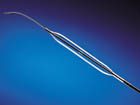
A typical over-the-wire
angioplasty balloon
Angioplasty balloon catheters come
in a wide range of lengths and diameters, and are made
from a variety of materials, but the major shared characteristic
is that the balloon can inflate to a certain diameter and
not beyond, thus allowing a predictable opening.
The positioning
of the balloon at the stenosis, its inflation and the
resulting increased flow post-angioplasty are all carefully
viewed
under fluoroscopy by the interventionist. Several inflations
are usually made before the procedure is considered finished.
Stents In more than 70% of interventions
today, a stent (a tiny metal structure which comes in a
variety of sizes and designs) is also used, usually following
a balloon angioplasty.
Sometimes the stent is used as
the initial therapy, called "direct stenting".
There are currently clinical trials being conducted to
determine the benefits of direct stenting over balloon-plus-stent.
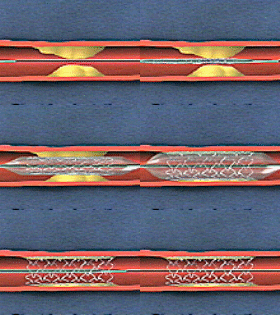
Stent
is on a balloon,
which is inflated and then
withdrawn, leaving
the stent behind.
Even if the
stent is utilized as the primary therapy, the process still involves
a balloon, for the stent itself is mounted on an angioplasty balloon
in order for it to be delivered to the diseased area and deployed.
The balloon is inflated, and the stent along with it. When the
balloon is deflated and withdrawn, the stent remains in place,
serving as a permanent scaffolding for the newly widened artery.
Within a few weeks, the natural lining of the artery, called the
endothelium, grows over the metallic surface of the stent.
Stents have virtually eliminated many of the
complications that used to accompany "plain old balloon angioplasty" (POBA)
such as abrupt and unpredictable closure of the vessel which resulted
in emergency bypass surgery. The additional structural strength
of the stent can also help keep the artery open while the healing
process progresses.
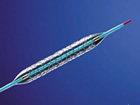
A
typical stent
mounted on a balloon
Drug-Eluting
Stents
A new type of stent, the drug-eluting stent or DES, has recently become
the overwhelming choice of cardiologists. Two types are currently available
in the in the United States: Boston Scientific's TAXUS paclitaxel-eluting
stent and the CYPHER sirolimus-eluting stent, made by Johnson & Johnson
/ Cordis. Both stents are basically a bare metal stent that has been
coated with a slow-to-moderate-release drug formulation, embedded in
a polymer. It is hoped that the medicine used will prevent or at least
reduce restenosis, reclosure
of the coronary artery, one of the biggest limitations of angioplasty
and causes for repeat procedures.
When the stent is placed, the drug is released
over time directly to the area most likely to reblock. Two types
of drugs currently are being used: an immunosuppressive agent,
sirolimus, and a chemotherapeutic drug, paclitaxel. Both have
proven effective in clinical trials that are currently underway,
bringing the restenosis rate from the 25-30% range down to low
single digits. If the very positive results from these devices
prove to be durable over time, many have said that drug-eluting
stents will revolutionize the treatment of coronary artery disease. (For more information
on drug-eluting stents, see our "HOT
TOPIC" on the subject.)
Angioplasty and Acute Myocardial
Infarction The emergency treatment of heart attack,
or acute myocardial infarction, has been dramatically affected
by these interventional devices. The combined use of balloons,
stents, and a variety of new drugs literally can stop a heart
attack in its tracks by quickly dissolving the clot, or thrombus,
opening up the obstruction, and restoring normal blood flow — minimizing
damage to the heart muscle itself. (For more information on
angioplasty in the setting of Acute Myocardial Infarction, see
our "HOT TOPIC" on
the subject.)
send comments & suggestions
to "info at angioplasty dot org"
Read our Privacy statement.
Angioplasty.Org is an editorially independent informational health
site
which has received unrestricted educational grants from Medtronic plc,
TCROSS NEWS, Toshiba
America
Medical Systems, Volcano
Corporation, Terumo
Medical Corporation
Cardium Therapeutics, Inc. and Lenox Hill Heart and Vascular Institute of NY














 Next
Section: "Atherectomy"
Next
Section: "Atherectomy"