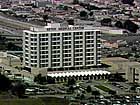
| Interview Richard K. Myler, MD |
||

|
|
|
| This is
the first part of our interview with cardiology pioneer Richard K.
Myler, M.D., who with Andreas Gruentzig
performed the first coronary angioplasty in the operating room in
San Francisco in May 1977. On March 1, 1978, Dr. Myler performed the
first coronary angioplasty in a cath lab in the United States. Dr.
Myler was a close associate and friend of Gruentzig, and in this exclusive
multi-part interview he traces the history of this procedure, and
offers some perspective on the current state of interventional cardiology. |
 |
|
|
||
| In the early 80's, Dr. Myler founded the San Francisco Heart Institute at Seton Medical Center, and has spent the past twenty years teaching the practice of interventional cardiology to physicians all over the world. He is the recipient of numerous awards and has published many papers throughout his long and distinguished career. Dr. Myler was recently honored with the dedication of a new state-of-the-art catheterization lab at Seton Medical Center. | ||
| Q: When did you first hear of "angioplasty"? Myler: The word angioplasty was developed by Dr. Charles Dotter in response to a technique that he and one of his (at that time) young associates, Melvin Judkins, developed in Portland, Oregon for opening up blocked arteries in the legs. Dr. Dotter derived it from the Greek words -- "angio", vessel -- and "plasty", capable of being molded -- and called their technique "transluminal angioplasty". |
||
|
||
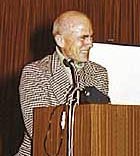  see video clip from
his 1964 movie |
In the movie there was a volcanic eruption. It was very dramatic. Just at the end of the movie he made a comment, a reference to the fact that though it was used in the legs, some day it might be used in other systems, including the coronary arteries. |
|
|
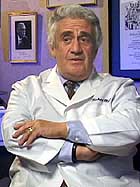
Sitting in the audience, with perhaps 60 or 80 people, I was stunned, absolutely stunned. The idea seemed so original and so simple. We had just landed on the moon, and I thought, if we can scoop up "moon dust" 387,000 miles from earth, could we not reach across a one meter catheter and somehow affect a plaque that was just a few milligrams in weight, and yet threatened a human life? |
 |
|
| With that thought bubbling in my mind, I called a friend who was also at the meeting -- John Abele, then the president of a small company in Watertown, Massachusetts called Medi-Tech. John was also taken with this possibility. They had worked in their company on some other devices, not necessarily for the coronaries, but John is an extraordinarily imaginative man and asked an associate of his, Itzhak Bentov, to work on a prototype. We had this in hand within one year. |
||
|
||
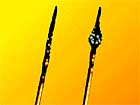 circa 1970 |
This was a 3.5F small catheter with a little cage device on the end which by opening would push material aside and as it closed it captured the material within it and then could be withdrawn. This was never used in a clinical trial. | |
| But John continued to show interest, and I continued to show interest and he would call me or we would visit together at one coast or another or at a meeting and we would chat about this. It was in 1976, he called me from the apartment of this young man in Zurich who had performed an angioplasty technique in dogs' coronaries. He said that this man, whose name was Andreas Gruentzig, was on to something and it would be good if we met. We chatted for a moment on the phone and set up an opportunity to meet him at the American Heart meeting in November. |
||
|
||
| I recall going up to meet Dr. Gruentzig who had a poster of this animal work. Most people who walked by him raised their eyes to the ceiling, implying, "this is kind of nuts!" -- which, by the way, was precisely the look I saw in the audience when Charles Dotter presented it some years earlier. | 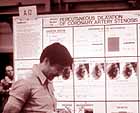 exhibit at American Heart Association (1976) |
|
| John introduced me and my wife Sharon to Andreas. We'd spoken on the phone and we'd written back and forth so we were prepared to meet each other. I looked at the poster and I remember turning to my wife and saying, "For God's sake, it's a balloon! It's a balloon...". And then after we talked for a while, I turned to Sharon and said, "We have to go to Zurich...now!" |
||
|
||
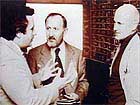 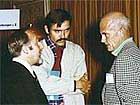 Myler, Zeitler, Dotter & Gruentzig in Nuremburg, 1977 |
I think there were three Americans there at the time: Dr. Dotter, a very nice fellow named Dave Kumpe, a radiologist from Denver, and myself. There were no more than 40 people in this small classroom and on the blackboard behind Dr. Zeitler was a list of all the places that did peripheral angioplasty in 1977 -- there were about 10 or 12. |
|
| Andreas was very much influenced by Dotter through his exposure to Dr. Zeitler. I've often said that Dr. Zeitler was really the "St. Paul" of angioplasty because he was able to introduce it in a very positive way in Europe. That was a frustration of Dr. Dotter in the United States since most physicians who did vascular work were surgeons and at that time and thereafter were very dubious of this procedure in the peripheral vessels. |
||

|
||
|
Angioplasty.Org Home • PatientCenter send comments & suggestions
to "info at angioplasty dot org" |
||